Saturday, May 20, 2006

Fleenor Recaptured!

May 20, 1907
Los Angeles

Night jailer O.L. Gilpin thought the man in the drunk tank looked familiar

Thursday, May 18, 2006

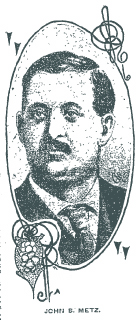
A Fine Metz He's In

May 19, 1907
Los Angeles


John B. Metz seems like just another suicide--the 44-year-old Deputy County Assessor was a well-dressed, well-trusted official-about-town who would often brood about how he would never marry because some girl had once jilted him. So when his body was found by the landlady at 514 South Wall Street, hanging out of bed with foam on his lips, self-administered poison was thought to be the death-dealing culprit.

Or could the positioning of his corpse be signs of a struggle? And what of the various recent sums of money, now missing, not properly turned into the Assessor's office? Yesterday, before his after-work bout of heavy drinking (including, perhaps, a carbolic of some sort) Metz failed to turn in $120 ($2,637 USD 2006) which remains missing to-day.

Metz was removed to Bresee Brothers Undertaking at 855 South Figueroa; they will perform an autopsy as to aid the inquest.

Mullen in Bad Plight


May 18, 1907
Los Angeles

William Mullen, a black strikebreaker for the Pioneer Truck Company, was delivering a shipment of lumber when he realized that he had lost some of his load and retraced his route to look for it.

At the Southern Pacific railroad crossing at Alameda and 2nd streets, Mullen noticed some lumber leaning against a shack belonging to a railroad flagman named Caulfield, who was presumably white. Mullen asked Caulfield if there was more of his lumber inside the shack and Caulfield said no.

Mullen challenged Caulfield, knocked him to the ground and began kicking him when Patrick Connelly, a union teamster for the Water Department and also presumably white, intervened, although it

Wednesday, May 17, 2006

Divorce Denied

May 17, 1907
Los Angeles


1907, as now, was full of drunken suicidal maniacs in the thrall of homicidal rage.  True, there are some differences now as opposed to then:  opium was a lot easier to get.  Divorces, less so.

H. A. Lyon, 70, met a 26-year-old Swedish girl by the name of Alva and, after knowing her a scant two weeks, married her.  She went on to burn all the pictures of his first wife, and all the letters he had kept.  Then Alva began to burn all of his incoming mail, especially those missives from his children; she consigned their pictures to the flames as well.  Moreover, she forbade him to go to church.  These troubles brought on two heart attacks which H. A. survived, and which convinced him he’d had enough.  

He therefore went before Judge Monroe to confess his mistake (Alva was not present, having gone on a short trip back to Sweden and only returned to the States as far as New York).  

Unfortunately for our hero, the Judge intoned from the bench:  “They couldn’t live together and she left him.  Apparently he was very glad to have her go, and gave her the money to take her away.  A divorce cannot be granted in this case, under the law, and I’m very glad it can’t be.”

To the Moon, Alice!

May 17, 1907
Los Angeles

The Le Canns continued their spat in court after Mrs. Le Cann showed Judge Chambers a piece of skin she said was torn from her lip when her husband, Fred (also listed as Ferdinand), shoved her as she was calling the police.

Monday, May 15, 2006

Mason Opera House


Those Sporting Ladies!


Los Angeles
May 15, 1907

Curious neighbors noticed recently that a large number of well-dressed women have been taking the streetcar to the end of the line at 54th Street and South Central Avenue while still others are arriving in automobiles. Upon investigation, Patrolmen Walsh and Murphy discovered that the women are gambling on horse races at a bookie joint set up next to the Ascot Park billiard parlor in a vacant lot surrounded by a high board fence.

Owners J.W. Carr and W.J. Murphy restricted the clientele to women, so police had a difficult time obtaining evidence, but finally officers raided the place and found 50 stylishly dressed women playing the ponies.

Sunday, May 14, 2006

Mad Mama!

May 14, 1907
Highland Park

Yesterday's claim by young  Merrill "William" McCormick that his mother Janette had been falsely dragged off to the bughouse as part of an elaborate interfamilial inheritance scam has been roundly denied by Arthur Randall, real estate man and the owner of the home on Avenue 66 from which the lady was seized.

Randall not only refutes any cousinship to the unhappy Mrs. McCormick, but insists that she is no heiress, but rather a con-woman with a long history of defrauding innkeepers and imposing upon the kindness of friends.

Mrs. McCormick is described as about 45, and handsome woman and a good talker, who is estranged from her family and separated from her husband. She was a cousin to the deceased husband of Randall's sister, Mrs. H.K. Pratt, who lives next door to her brother and their sister Mrs. Mabel Bennett. Out of consideration for that slim tie, McCormick and her son were recently welcomed into the Bennett-Randall manse when her habit of masquerading as a woman of means in order to secure fancy hotel lodgings for which she could not pay reached its inevitable conclusion.

But after a few days residence, McCormick's odd, oftimes abusive behavior became distressing to the siblings. They believed her to be insane, and while sympathetic, demanded that she find alternate lodgings. She responded with a threat upon Randall's life, so he swore out a warrant for her arrest. The lady ran away ahead of the Sheriff, but returned to break a window, whereupon she was captured.

Randall expressed concern for 15-year-old Merrill, a strong boy who ought to be working rather than following his mad mama from hotel to hotel, absorbing her weird fantasies and parroting them back at police officers. Randall offered to help the boy, but Merrill refused, insisting he would stay with friends and fight for his mother's freedom and the vast fortune of which she was being deprived.

Saturday, May 13, 2006

News N' Notes

May 13, 1907
Los Angeles

Check the barometer: rising suicide, murder and drunkenness let us know there's a good chance of 1907 to-day.

Lena Rossester lived in a bungalow at 604 Vitmer with a younger man--some would say her son, but the gentleman won't give his name and begs that Lena's recent fatal carbolic cocktail be suppressed by the press (no such doing here!); D. Orlackey made a move to murder his family at 1021 E. 54th, but his wily wife locked him in the closet until authorities could arrive; and Thomas Dunn, of no fixed address, made a bed of the Hollywood Electric tracks until rudely awakened by the fender of a trolley that took a good chunk out of his head (he'll be fine--nothing a visit to the oft-mentioned Receiving Hospital can't fix).

Ah, the touchstones of our time.

Mad Mama?

May 13, 1907
Highland Park

15-year-old William McCormick visited the police to make a panicked plea for the salvation of his mother Janette, removed yesteday from 228 South Avenue 66 to the lunatics' ward of the County Hospital. His mother is, William swears, quite sane, and her confinement the result of a family plot to steal her inheritance.

Mrs. McCormick is the primary beneficiary of a million dollar estate based in Denver, although much of the family lives on the west coast, including cousin Arthur Randall, in whose home the McCormicks had been staying.

Although no warrant for the woman's arrest was ever produced, Superintendant Barber of the County Hospital accepted the word of the deputy sherrifs who brought the shrieking woman into his ward that such a warrant was in the hands of the Sheriff, and he refuses to release his captive until the case is investigated today.

Young McCormick explains, "After the death of my grandmother, mother and I came to the Coast. When our relatives learned that the greater portion of the property was left to mother and me, they began to plot. While we were in San Diego, Mrs. Belle M. Auston, who now lives in Black River Falls, Wis, and is my aunt, tried to kidnap me and was unsuccessful."

After this shock, the pair moved on to stay with a lady cousin in Ocean Park, then moved in with cousin Arthur. "He is the one who is making this trouble for mother. She is sane and has never been troubled with any symptoms of insanity. I believe that my uncles N.M. Phelps and A.D. Merrill of Denver have hired Randall to try to get mother in an asylum, so as to get her fortune! Phelps was left only $5000 by my grandmother's will and Merrill was not mentioned. I am not very old, but I don't want to see them harm mother."

The police sargeant told the youngster to contact the District Attorney.

Wednesday, May 10, 2006

A Murderous Sweep

All K. Tanimura wanted to do was clean the carpets at the Hotel Angelus at 407-411 S. Spring St. The sweeper, however, was broken so he sought help from the hotel

Tuesday, May 9, 2006

Horse Abuse At the Fiesta

May 9, 1907
Los Angeles

The spies of the SPCA were watching closely as the Fiesta electrical parade wound its way down Broadway last night, ready to spring forward in defense of the poor animals on whose shoulders so much of the festivities rests.

Sure enough, rider W.S. Voorsanger was spotted at 2nd and Broadway, spurring his horse so violently that blood showed on its flanks. Officer Mitchell approached Voorsanger to rebuke him, but the man galloped away, then pushed his mount into a run. Commissioning a nearby automobile, the SPCA officers gave chase, capturing their quarry near Fourth and Main. Voorsanger will stand trial in Police Court today on a charge of animal abuse; he claims he did not realize he was harming the horse, and gives no excuse for running.

Voorsanger... isn't that Dutch for "to make bloody"? 

Shriners Present a Colorful Array

What, you might ask yourself, did Shriners do before the advent of those little cars and Harley- Davidson Electra Glides? The elaborately costumed men staged precision, close-order drills accompanied by marching bands.

The effect, according to The Times, was stunning, inspiring the unidentified author to summon forth his (or possibly her) own gaudiest prose.

Monday, May 8, 2006

A Fish Story

May 8, 1907
Long Beach 

While fishing off the Long Beach pier, Harry Hamilton, a visitor from Prince Edwards Island, Nova Scotia, made a spectacular catch, which required a hard and frenzied battle to drag the creature from its briny home up to pier-level. It was only after subduing the finny fellow that Hamilton realized that his valuables--$325 in cash, a ticket home, and a diamond ring--were no longer in his pocket.

It is unknown if his property fell into the water while Hamilton was preoccupied with his catch, or were they snatched by a pickpocket, but the sad fact remains that Harry Hamilton, who was this morning well equipped to enjoy his stay in Fiesta-time Los Angeles, now possesses just his luggage and a large fish. Anyone who wishes to buy said fish may contact Hamilton c/o this website. 

The Packing Padrone

May 8, 1907
Long Beach

The Padrone must run a tight ship. Juan Acosta is a Padrone. He has a shotgun.

Just east of the city, at the Bixby Ranch, he discharged four men from one of his tents for reasons unmentioned. These gentlemen returned before daybreak and one of them, a Juan Diaz, stabbed a sleeping Acosta through the arm, and then stuck him in the breastbone and forehead. Acosta still managed to grab his shotgun and unload onto Diaz' abdomen at point-blank range.

El Padrone's brother managed to tackle and hogtie another assailant, one Luciano Morro, who was found bound at the entrance of the tent by local Marshals. The two others, Mssrs. Bartello and Rodriquez, now have warrants out for their arrest.

Padrone Acosta is expected to pull through. The outlook for Diaz is not as rosy.

I Love a Parade...You Fools!

May 8, 1907
Los Angeles

One expects Fiesta-time to be fortuitous to the light-fingered gentry (e.g., V. S. Hawley had a $30 gold watch taken from his pocket; E. E. Leech was relieved of $7 while standing on Main Street watching the floats) but when goods are taken by the wagon-load, then we've got serious business afoot. No fewer than nine major break-ins were reported last night. The thieves in each case were evidently experienced operators, who feared little for being molested during their duties, especially given as in every instance the intrusion coincided with the Fiesta parades between 8pm and 12am. Further, the thieves had discriminating taste: at the home of S. H. Garrett, where entrance was gained through a rear window, purloiners went through the wardrobe and selected the finest of silk dresses and evening clothes to purloin; they even absconded with the better bedclothes. At 2629 Orchard Avenue, W. W. Taylor lost a gold watch, chain, necklace, and locket; at the same address Mrs. William Fleckenstein was relieved of her opera glasses and solid silver flask. Most astonishing was the haul from Mr. Nelson Douglas of 2500 Vermont Avenue, wherein unpacked suitcases belonging to his Shriner guests were lifted in toto. Watches, jewelry, money in the children's bank; all are in the hands of Los Angeles' dark and shadowy underworld this day.

Kissing, the Old-Fashioned Way

Sunday, May 7, 2006

They Ain't Buying It

May 7, 1907
Los Angeles

Jesse C. Cowd, of 187 South Broadway, told cops he was shot in the groin in the rear toilet-room of the Southern Hotel saloon at Market and Main...when an unidentified stranger dropped a revolver and it discharged on the floor. Cops don't buy the story--the trail of blood leads from the cigar stand in front of the saloon where there had been a quarrel over a dice game. Despite there having been a large crowd at the time, there were, of course, no witnesses.

And the Dog Came Back

May 7, 1907
Fullerton

Constable Edwards has a bulldog that his children have been playing with for two years. A neighbor's child was over a few days ago and was bitten on the arm. Instead of taking responsibility for raising a beastly child that doesn't know not to torment dogs, the evil neighbor requested of City officials that the dog be killed.

The City Marshall went to the home of Mr. Edwards and rightfully requested that Mr. Edwards be more careful with the dog in the future, while the neighbor still held that the dog be killed. The Marshall departed but the neighbor kept at it, and dog owner Edwards finally consented to have the dog murdered.

The neighbor walked the dog down the Fullerton railroad tracks and shot him. The dog rolled over and after a few minutes stopped kicking. The neighbor returned to town and reported that the deed was done.

That night in the Edwards home the mantle clock ticked in earnest in its dreadful march to midnight when, moments before it chimed twelve, there was a scraping at the door. Mrs. Edwards opened it. "Is this the ghost of the dog or am I dreaming," she said to herself. Mr. Edwards rubbed his eyes and nearly toppled over as he joined his shocked wife in watching the dog crawl toward them--coming slowly forward--until as the dog shook his head a ball fell from his jaw. Mr. Edwards says the dog will live. Hopefully it will finish off that family next door.


A Poem for La Fiesta Del Los Flores


John Steven McGroarty, The Times columnist and staff poet, offered this tribute to the annual La Fiesta de los Flores, which coincided with the national Shriners convention.

The fiesta featured four parades of vehicles decorated with electric lights. The Times described one of them as

Saturday, May 6, 2006

Barney Oldfield's Green Dragon Blazes Through Los Angeles


What is it about Angelenos that as soon as you put them behind the wheel of a car, they want to see how fast it will go?

But it

Covetous

Inspired by the birthday wishlist of LA Brain Terrain blogiste Adrienne Crew, Rodger Jacobs has posted his own five-things-most-desired list, and asks that your humble editrix do the same. It is not nice to stir peoples' covetousness. I can not rest until such a selection is compiled. And so:

1) a landscape by Léon Spilliaert 

2) a green Fortuny Delphos gown 

3) the full set of Grandville's fleurs animes, still in the book and not canibalized for prints.

4) an image of Bruges by Fernand Khnopff

5) A forty-year-old dioscora macrostachys from the California Cactus Center

Tagging: Nathan Marsak, Richard Schave, Ryan at Losanjealous, L.A. City Nerd 

Friday, May 5, 2006

Alcoholiquality During Fiesta

May 6, 1907
Los Angeles

The rough-necked gentry of the Seventh Ward are known for the signs in their saloon windows that read "No Colored Persons Served Here" or just "No coons wanted." When the City Council decided to abolish race discrimination during Fiesta, the removal of these signs was of primary importance, so the powers that be got to work on the matter without the usual requisite public discussion. This made those in the bartending profession feel persecuted, and the number of these signs, especially in the many bars along East Main Street, greatly multiplied.

In response, black leaders began organizing "runs" on various white bars, wherein black patrons would mob selected establishments as an example and warning. One of our trademark race riots seemed imminent. Luckily, instead, black delegates from the Sixth and Seventh wards mobbed City Hall, where Mayor Harper and City Attorney pushed through an official legal ordinance banning race discrimination and making the signs unlawful.

Theaters, of course, remain segregated.

One Less Sailor in Pedro

May 6, 1907
San Pedro

The British bark Falls of Gary arrived in San Pedro tonight, 144 days from Antwerp, journeying around the Horn to bring a load of cement to Los Angeles. An uneventful journey, except that they arrived one man short. James Milligan, cook and steward, had been drinking heavily before the vessel set off. At one day out he was put to bed by shipmates and when sought again, had vanished. The disappearance is being considered a suicide.

Not a shocking story in and of itself--but one must wonder: cement? Had Los Angeles not evolved to the point of discovering the wonders of water mixed with gypsum? Granted, I love Hassids and Quentin Metsys and Belgian chocolate, but what makes Flemish cement so precious that it must be imported here on three-masted vessels flying the flag of Edward VII?

Shriners Ban Water Except for Bathing


Singing loud praises to Allah that strike a curious note in 2006, the special train of Shriners is flying across the Nevada desert brimming with Freemasons and their families pondering the ancient mystery:

Of Human Bondage

May 5, 1907
Los Angeles

Mary Hawn is by all accounts an attractive twentysomething, average enough perhaps, save that she has a Superior Court case today. And she was bound and gagged in her bed by an intruder last night.

"Being very much exhausted and having retired rather late, I fell into a sound sleep. When I can next remember I seemed to feel someone's breath above my head. My mouth hurt me and someone was cramming it full. I opened my eyes and tried to move. Then I was frozen with horror. A masked man was leaning over me and was finishing the work of gagging me.

"Oh, it seemed for such a long time he bent foreward, gazing into my face. Then I tried to move and found my hands and feet bound together. After what seemed to me a long time, the man raised up and walked to the bureau. He searched it and then returned, he whispered that he would kill me if he did not find my papers before long. After making other threats at my life, he left."

This occurred in her room at the Golden West Hotel, 412 South Main Street. Which Miss Hawn owns; she purchased the hotel from a Covina man in May of 1906. Little is known about their relationship, except that a) the hotelman died a short time later, and b) he left his life insurance to Miss Hawn, some one thousand dollars.

And the Superior Court case? The mysterious man's widow is suing Miss Hawn for the insurance money. It is papers relating to this case that Miss Hawn alleges her visitor was after.

Thursday, May 4, 2006

The Autoist: Our Modern Scofflaw

May 4, 1907
Los Angeles

Ten autoists were hauled into Police Court this morning for breaking speed ordinances, and another two were in attendance for having failed to place rear lights on their machines. All were fined fifteen dollars apiece.

The police assure more arrests of these auto men will follow.


In a Lonely Place

May 4, 1907
Riverside

Jesus Chavez was traveling from his home in El Monte to Colton, where he intended to celebrate Cinco de Mayo. During the trip Chavez was under the intoxicating influence of liquor continuously, and for reasons unknown shot and killed one Veranze Mansibai on a lonely road near West Riverside.

Chavez went into hiding, but Sheriff Wilson and Under Sheriff Evans eventually encountered his spring wagon. A little further on they found the white and bay horses he was driving. And a little after that, the tiny cabin in which Chavez was tightly holed up, continuing his alcoholiday.

There is little hope Chavez will be able to answer to the charges before the effects of his spree wear off.

Our Struggling Authors

In grappling with a novel about life in prison, writer Ernest Filer of Chicago decided that he should experience imprisonment for himself , thus he hatched the idea of breaking a window so he would be sent to jail.

He selected a small pane of glass at a cigar store and heaved a rock through it, assuming that he would be let off with a reprimand, a day or so in jail and an order to pay the cost of replacement.

The Cook County judge, however, took a dim view of his literary endeavors and

Wednesday, May 3, 2006

The Shriners Are Coming!

Preparations are nearly complete for the Shriners Convention, which begins May 7 with the city

Mayor Harper Likes to Watch Young Girls -- Hurdle Tombstones!

May 3, 1907
Los Angeles

The old cemetery adjacent to Los Angeles High School was a lonely and forlorn place, until a throng of young ladies from the HS girls' track team made it their training quarters. The fair hurdlers and sprinters had important dates upcoming, and the disused graveyard was the only place they could practice--until the grizzled old caretaker descended on the girls as they footed it in and out among the memorials. He was responsible to the Mayor for the condition of the place, he told them, and if he let girls practice there, then boys would come 'round, and if boys came 'round, then the peace of the place would forever be destroyed. So the girls would have to go, he insisted.

Naturally, wind of this got to Mayor Harper, who disclaimed all complicity with the cruel edict, and went on to state that he likes to see girls leap over monuments and generally make the place lively. "Why, it's good for them. Let the girls hop over tombstones if they want to. I like to have them," said Mayor Harper. "If the girls are anything like they used to be they're welcome to all the room they want." Harper even went so far as to flourish the official pen and scribble out a permit allowing the girls to roam at will in the old Los Angeles cemetery adjoining the High School building, provided they did not desecrate any graves.

And that, children, is how young girls in the bloom of youth, their airy flights and frolics so delightful to the eye, got their graveyard privileges restored.


Tuesday, May 2, 2006

Adventures in Dining

Nicholas

Eye of a Needle

May 2, 1907
Los Angeles

Wealthy real estate mogul Russel C. Carter, 939 Denver Avenue, was at 74 in the winter of his years, though comfortably retired. Despite his vast holdings he brooded over ailments real and imagined and obsessed over the idea he would become helpless, an issue he confided only to his son, Spring Street haberdasher Norman Carter.

So, when his wife left the house to-day to go about her day’s business, R. C. barricaded himself in the barn, secured a rope to both a beam and his neck, and leaped off a stairway. When Mrs. Carter returned at 6:30, the patriarch nowhere to be found, neighbors were enlisted to break down the barn door, where she found her husband still swinging.

She was prostrated with grief and is now under the care of physicians at son Norman’s home at 3616 Flower Street.

While there is much to say about the moneyed class and their admirable relationship to self-determination, this writer merely wishes to send his condolences to the family of an Angeleno with vision.

Train Electro-Charged!

May 2, 1907
Los Angeles

Area men Peter Matlock, Morris Ross, and D. J. Berry were waiting for the Pacific Electric car at the Pine Avenue station with the usual mob making the usual Thursday afternoon rush, and had the good fortune to be at the forefront of the throng.

Though when the trolley approached and they grasped the metal guard rails to pull themselves on board, the crowd leapt back as the three men began convulsing in bizarre contortionist fits. With super-human strength they tore themselves from the train, falling heavily to the pavement, dazed and shocked beyond measure, their blistered hands a testament to the defective wiring and improper grounding--that most base, yet heady, of electrical cocktails--that had caused 500 volts to course through the car.

With stern reserve and newfound respect for Mr. Edison, they still caught the next car home.

Sunday, April 30, 2006

Edward M. Robbins -- Man of Mystery, Suicide of Curiosity


Los Angeles
April 30, 1907
 
Sixtysomething Edward M. Robbins was a Civil War vet and long-time resident of his little house at 2728 Council Street.  No one ever entered the threshold of his hermit home; he never spoke to his neighbors nor made sign of recognition when he passed them on the street.  He was a quiet and at all times inoffensive man, save for those occasional spells when he would go on a colossal drunk. Then he would be seen through the uncurtained windows strumming an old guitar for a time, until he broke into mad fits of rage, pacing and singing at the top of his voice.
 
Given his hermit-like ways, it was no wonder that Robbins’s ten-day disappearance went unnoticed.  But then passersby observed the multitude of flies on the windows…
 
Police broke in to find Robbins on a bed he’d covered in wrapping paper. Bowie knife, razor and pair of scissors were all nearby, all besmeared with blood, as Robbins had used them all on his wrists and ankles.  But what led to his self-destruction was a “queerly fashioned double barreled pistol of ancient make” that Robbins still gripped tight in his decomposing hand, one barrel having been discharged to form a gaping hole in his neck.
 
Perhaps Robbins suffered from the mania associated with the  “flashing back” of memory common to veterans of the War of Northern Agression.